Guides
Etao
Release notes for Etao (runtime v480, root-off-the-top fix in v481) — subnets choose how their alpha emission is split between owner, validators and miners, while root TAO stakers are paid their baseline share off the top every block. What changed, the rules, the migration, and the CLI.
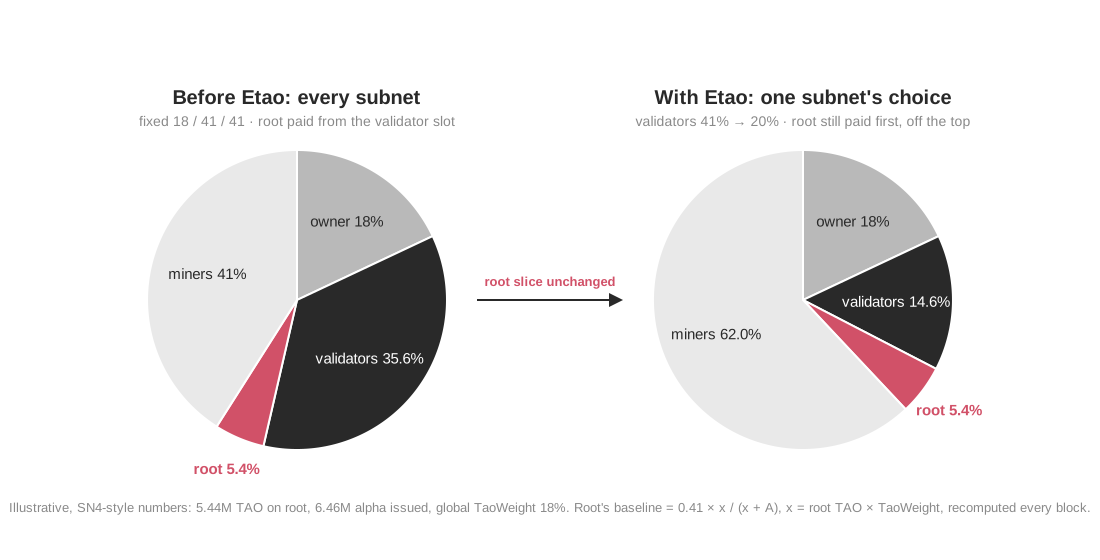
Etao (runtime v480, with the root payout rule finalised in v481) hands every subnet owner the dial that used to be welded shut: how the subnet's alpha emission is divided. For five years every subnet paid the same split — 18% to the owner, 41% to validators, 41% to miners. Now a subnet that lives on its miners can pay them 62%. A subnet that needs deep validation can push validators to the 50% cap. An owner who wants to signal commitment can set their own cut to zero. One extrinsic, one rate limit, five rules, and a guarantee underneath all of it: root TAO stakers are paid exactly what they would be on an untouched subnet, whatever the owner picks.
This page is the complete release note. It covers what changed and why, how the vector and its rules work, how root stays whole, the migration, the deprecated calls, every new storage item, event, runtime API, EVM function and SDK/CLI surface, worked CLI examples for owners, and what validators, miners, root stakers and integrators should expect.
Summary
- New: a per-subnet emission weight vector
[burn, recycle, owner, validator, miner]ofu64parts ofu64::MAXthat sums to exactly one. - New extrinsic:
AdminUtils.sudo_set_subnet_emission_weights(netuid, uids, values)— a sparse update callable by the subnet owner (once per 50,400 blocks per subnet) or root. - Rules (v1): burn = recycle = 0;
0 ≤ owner ≤ 33%(lease-created subnets≥ 18%);validator ≤ 50%and strictly above root's live baseline share;miner ≥ 33%; the five slots sum to exactly one. - Root stays whole: every block, root TAO stakers are paid their
baseline share of the subnet's emission — what they would earn with
the default validator share and the global
TaoWeight, recomputed from live chain state — off the top of the validator slot, capped at the slot. Alpha validators share what is left. Nothing the owner sets, and no later drift in stake or issuance, moves root's payout away from the baseline. - Migration: every live subnet is seeded from its legacy owner-cut state. Payouts in the first post-upgrade block are identical to the last pre-upgrade block.
- Deprecated:
sudo_set_subnet_owner_cutandsudo_set_owner_cut_enablednow returnDeprecated; the owner slot replaces both. - Surfaces: runtime API
get_subnet_emission_weights, eventSubnetEmissionWeightsSet, three hyperparameters (owner_emission,validator_emission,miner_emission), EVMsetSubnetEmissionWeights/getSubnetEmissionWeights, theset_subnet_emission_weightsintent andsubnet_emission_weightsread in the Python SDK, andbtcli subnets emissionwithshow,set,set-value,increaseanddecrease. - Ships to mainnet as a sudo runtime upgrade from
main;spec_version481 (480 introduced the vector; 481 replaced its set-time TAO-weight solve with the per-block root payout described here and removed theSubnetTaoWeightstorage item).
Why
Bittensor subnets are not alike. Some are miner-heavy compute markets where validation is cheap and the scarce resource is miner effort. Some are judgment-heavy and need validators to spend real money to score work. Some are owner-run products where the owner cut funds the team; others want the owner cut gone so every token flows to participants. A single fixed split cannot serve all of them, and until now the only knob — the owner cut — was a global sudo setting, the same for every subnet.
The obstacle to letting owners move the validator share was root. Root TAO stakers are paid from the validator slot of every subnet in proportion to their TAO-weighted stake. Let an owner cut the validator slot from 41% to 20% and, with nothing else changing, root's income from that subnet would halve. Owners would be able to tax a network-wide stakeholder to pay their own participants. Etao removes that coupling: the validator slot becomes a choice about validators, and root's payout is pinned to a baseline that the owner cannot move.
The emission weight vector
Every subnet carries a five-slot vector that says how each block's alpha emission is divided:
| Slot | Name | Paid to | v1 rule |
|---|---|---|---|
| 0 | burn | nothing — alpha is destroyed | must be 0 (reserved) |
| 1 | recycle | nothing — alpha returns to the unissued pool | must be 0 (reserved) |
| 2 | owner | the subnet owner's hotkey at each epoch | 0 ≤ owner ≤ 33%; lease-created subnets ≥ 18% |
| 3 | validator | root's baseline share first, then alpha validator dividends | ≤ 50%, and strictly above root's baseline share |
| 4 | miner | miner incentive, split across the subnet's mechanisms | ≥ 33% |
Each slot is a u64 share of u64::MAX, so the five slots sum to exactly
one with no rounding dust. Per block, alpha_out × owner accrues to the
owner, alpha_out × validator to the validator bucket and
alpha_out × miner to the miner bucket. Burn and recycle are present so the
format does not change when they are switched on in a later runtime; today a
non-zero value in either is rejected.
The owner slot at zero means "no owner cut". The old owner_cut_enabled
reading is now simply owner > 0; the auto-lock of the owner cut
(owner_cut_auto_lock_enabled) is unchanged and applies to whatever the
owner slot pays.
Setting it
AdminUtils.sudo_set_subnet_emission_weights(netuid: u16, uids: Vec<u16>, values: Vec<u64>)The update is sparse: uids[i] names a slot and values[i] its new
share. Omitted owner / validator / miner slots keep their current value;
omitted burn / recycle are treated as zero. The merged vector must pass
every rule, and each rule has its own error so a rejection names the
constraint:
| Error | Rule |
|---|---|
BurnEmissionMustBeZero | slot 0 must be 0 |
RecycleEmissionMustBeZero | slot 1 must be 0 |
OwnerEmissionAboveMaximum | owner > 33% |
LeasedSubnetOwnerCutBelowMinimum | lease-created subnet with owner < 18% |
ValidatorEmissionAboveMaximum | validator > 50% |
ValidatorEmissionTooLowToPreserveRoot | validator ≤ root's live baseline share, so alpha validators would get nothing (see below) |
MinerEmissionBelowMinimum | miner < 33% |
EmissionWeightsDoNotSumToOne | the five slots do not sum to exactly u64::MAX |
EmissionWeightsNotSettableOnRoot | netuid 0 has no alpha emission to divide |
EmissionWeightIndexOutOfRange / EmissionWeightIndexDuplicated / EmissionWeightsLengthMismatch | malformed uids / values |
Callers: the subnet owner coldkey, or root. Both obey every rule including
the lease floor, and both respect the admin freeze window. Because the slots
must still sum to one, lowering one slot means raising another in the same
call; btcli does that arithmetic for you (below).
Rate limit
Owners may change a subnet's vector once every 50,400 blocks (about
seven days at 12 s). The limit is keyed by subnet, not by owner coldkey
(LastRateLimitedBlock[OwnerHyperparamUpdate(netuid, EmissionWeights)]), so
handing a subnet to a new owner does not reset it. A subnet's first change is
never rate-limited, root is exempt, and dissolving a subnet clears the key so
a reused netuid starts fresh. The window is a runtime constant
(SubnetEmissionWeightsRateLimit), not a hyperparameter.
How root stays whole
Root TAO is weighted against alpha by the global TAO weight w
(TaoWeight, 0.18 on mainnet today, governance-set). Before Etao, each
block's alpha to root stakers from a subnet was
root_alpha = V × x / (x + A) × alpha_out with x = root_tao × wwhere V was the fixed 41% validator slot and A the subnet's alpha
issuance. Root's share of a subnet's emission was the same formula
everywhere, and it moved only with root stake, issuance and the global knob.
Etao keeps exactly that payout and detaches it from the owner's choice of
V:
Root off the top
Every block, for every subnet, the chain computes root's baseline share
r = V0 × x / (x + A) with x = root_tao × TaoWeightV0 is the validator share of the default vector (0.41 on mainnet, derived
from the default owner cut; one global constant, no per-subnet storage).
r is what root would earn from the subnet right now if the owner had never
touched the vector. Root is then paid
root_alpha = min(V, r) × alpha_outoff the top of the validator slot, and alpha validators share the remainder,
(V − min(V, r)) × alpha_out. The owner and miner slots are untouched.
Because r is recomputed from live state on every block, root's payout
tracks the baseline continuously: as alpha issuance grows against root
TAO, as root stake moves, or as governance changes TaoWeight, root earns
exactly what an untouched subnet would pay at that block — with no further
call from anyone. A subnet whose owner has never changed the vector pays
V0 × x / (x + A), identical to the chain before Etao.
Two consequences:
- The owner cannot move root's payout. Lowering
Vfrom 41% to 20% takes the whole 21 points from alpha validators; root's slice is the same before and after. RaisingVlikewise pays only alpha validators more. There is no per-subnet weight to solve, store or ratchet. - Everything else is the plain global
TaoWeight. Stake weighting inside Yuma Consensus, the TAO-versus-alpha split of validator dividends, the child/parent stake inheritance and the pool side all use the global knob exactly as before Etao.
When a change is rejected
The set call fails with ValidatorEmissionTooLowToPreserveRoot when the
requested validator share is at or below root's live baseline,
V_new ≤ r: root would take the entire slot and alpha validators would
receive nothing. The floor is therefore r itself, not a multiple of it.
On a mainnet subnet with 5.44M TAO on root, 6.46M alpha issued and
TaoWeight = 0.18, the baseline r is about 5.40% of emission, so the
validator slot can go down to anything strictly above 5.40%. The floor
moves with root stake, the subnet's issuance and the global weight, so
btcli subnets emission show prints the live value, and every write checks
it locally before anything is signed. With no root stake there is nothing to
preserve and any positive validator share is accepted.
The capped case
The check runs at set time; the baseline keeps moving afterwards. If a subnet
sets V just above today's r and the baseline later grows past it (root
stake rises, issuance falls, or governance raises TaoWeight), root's cut is
capped at the whole validator slot: root is paid V × alpha_out and alpha
validators receive nothing until the owner raises V again. Root is never
paid more than the slot, and the owner can always restore validators by
raising the share (root is exempt from the rate limit, so governance can fix
a stuck subnet immediately). btcli subnets emission show flags the capped
state and the runtime API reports both root_baseline_share and the
root_share actually paid.
What does not change
The pool side is unchanged. tao_in, alpha_in, the alpha-injection
cap and RootProp use the global TaoWeight, exactly as before. Changing a
subnet's vector changes how its alpha is distributed; it does not change
how much TAO or alpha is injected into its pool, and it does not change
prices, swaps or the emission the subnet receives.
Migration and compatibility
The v480 upgrade ran one migration, seed_subnet_emission_weights_v1,
which seeds every live subnet so that the first post-upgrade block pays out
exactly what the last pre-upgrade block did:
owner= the legacySubnetOwnerCutscaled tou64parts whenOwnerCutEnabledwas true, else 0;validator= half of the remainder (the old 50/50 split);miner= whatever is left, absorbing the rounding ulp;SubnetCreatedViaLease= true for subnets with a live lease mapping (the lease floor on the owner slot applies to them);SubnetOwnerCutAccrued=alpha_issuance × legacy SubnetOwnerCut— the exact deduction the legacy lock refund applied — so dissolving a subnet later pays no more than it would have. Subnets already mid-dissolution get this seeded too, so their pending refund is correct.
The v481 upgrade runs remove_subnet_tao_weight_v1, which deletes every
SubnetTaoWeight entry the v480 set-time solve wrote (the per-block baseline
replaces them) and touches nothing else. One side effect to know about:
subnets whose legacy owner cut was disabled were seeded at v480 with a 50%
validator slot and, under the v480 rule, paid root 0.50 × x / (x + A).
Under v481 they pay the global baseline 0.41 × x / (x + A) like every other
subnet — about 18% less root alpha on those subnets, and correspondingly more
to their alpha validators.
Newly registered subnets are seeded with the default vector
[0, 0, 18%, 41%, 41%]. Dissolving a subnet clears its vector, lease
marker, accrued owner cut and rate-limit key, so a reused netuid starts
clean.
Deprecated extrinsics. AdminUtils.sudo_set_subnet_owner_cut and
AdminUtils.sudo_set_owner_cut_enabled keep their call indices and SCALE
signatures but always return Error::Deprecated. Set the owner slot
(including to zero) through sudo_set_subnet_emission_weights instead. The
SubnetOwnerCut and OwnerCutEnabled storage items remain readable as
legacy views but are no longer written.
New chain surface
Storage (pallet SubtensorModule):
| Item | Type | Meaning |
|---|---|---|
SubnetEmissionWeights | netuid → BoundedVec<u64, 5> | the vector; defaults to [0, 0, 18%, 41%, 41%] |
SubnetCreatedViaLease | netuid → bool | marks lease-created subnets (owner floor 18%) |
SubnetOwnerCutAccrued | netuid → alpha | owner cut paid out so far; deducted from the lock refund on dissolution |
Event: SubtensorModule.SubnetEmissionWeightsSet { netuid, weights }
carries the full post-merge five-slot vector.
Rate limit: TransactionType::OwnerHyperparamUpdate(Hyperparameter::EmissionWeights)
keyed by subnet in LastRateLimitedBlock; constant
SubnetEmissionWeightsRateLimit = 50_400.
Runtime API / RPC: SubnetInfoRuntimeApi.get_subnet_emission_weights(netuid) → Option<SubnetEmissionWeightsInfo { netuid, weights, burn, recycle, owner, validator, miner, root_baseline_share, root_share, created_via_lease }> (API
version 3). root_baseline_share is r and root_share is min(V, r), both
in u64::MAX parts at the queried block.
get_subnet_hyperparams_v3 also reports owner_emission,
validator_emission and miner_emission as u64 parts.
EVM (subnet precompile, index 2051):
function setSubnetEmissionWeights(uint16 netuid, uint16[] calldata uids, uint64[] calldata values) external;
function getSubnetEmissionWeights(uint16 netuid) external view returns (uint64[] memory weights, bool createdViaLease);
Shares are uint64 / type(uint64).max. The setter is dispatched from the
caller's mapped coldkey and must pass the same rules; a rejected set reverts
with the chain error name.
Python SDK:
- read
subnet_emission_weights(netuid)→ vector, shares, the global TAO weight, root's baseline share and the share actually paid, what alpha validators keep after root, whether root's cut is capped, the live validator floor, lease flag, rate-limit state; - intent
SetSubnetEmissionWeights(netuid, slots, values, renormalize=False)→ sparse set with an optional proportional renormalisation of the untouched slots; its plan lists every rule the chain would reject and a structuredpreview(before/after vector, root's share before and after, what alpha validators keep before and after, the capped flag, rate limit, allowed ranges); - module
bittensor.emission_weightswith the pure rules (validate,renormalize,baseline_root_share,validator_floor,root_share_paid,preview) so you can check a vector offline.
CLI: btcli subnets emission show | set | set-value | increase | decrease.
For subnet owners: step by step
Every command below takes --json for a machine-readable record with stable
field names and --dry-run to preview a write without signing. Exit codes are
fixed: 0 done; 1 the subnet does not exist, the change is blocked
right now (owner rate limit) or the chain rejected it; 2 invalid input or
a vector the chain's rules would reject.
1. Look before you touch.
btcli subnets emission show --netuid 4subnet 4 emission weights
Vector
owner 18.00% 3320329489486196244 parts
validator 41.00% 7563207292111677685 parts
miner 41.00% 7563207292111677686 parts
burn 0.00% reserved, pinned to 0
recycle 0.00% reserved, pinned to 0
Root
root share of emission 5.4015% what root TAO stakers earn from this subnet now, paid off the top of the validator slot
root baseline share 5.4015% with the default validator share and the global TaoWeight (18.00%); recomputed every block, so it moves with root stake and alpha issuance, not with this vector
validators after root 35.5987% what alpha validators share once root is paid
validator floor > 5.4015% a change must leave the validator share above the baseline
root tao 5,443,000 TAO
alpha issuance 6,457,000 alpha
next owner change now first change; owners may change once per 50,400 blocks
created via lease no
Allowed
owner 0.00% to 33.00% 0 turns the owner cut off
validator 5.4015% to 50.0000% must exceed root's baseline share, which is paid off the top of this slot
miner >= 33.00% miner incentive floor
burn = 0% reserved for a future runtime; must stay 0
recycle = 0% reserved for a future runtime; must stay 0
sum = 100% all five slots add up to exactly 18446744073709551615 parts
help: change one slot with btcli subnets emission set-value --netuid 4 --slot owner --value 10% (the other two rescale to fill 100%); add --dry-run to previewThe Allowed table is live: the validator floor is root's baseline share computed from root stake, your subnet's issuance and the global weight at this block (the lowest accepted value is one part above it).
2. Preview the change. Move one slot; the other two rescale to fill 100%:
btcli subnets emission set-value --netuid 4 --slot validator --value 20% --dry-runrequires: subnet owner coldkey
dry run: set emission weights on netuid 4: validator=20.00% (renormalizing the rest)
signer owner (5F...)
est. fee τ0.000216036
effect set emission weights on netuid 4: validator=20.00% (renormalizing the rest)
effect vector: owner 18.00% / validator 41.00% / miner 41.00% -> owner 24.41% / validator 20.00% / miner 55.59%
effect root keeps its baseline 5.4015% of this subnet's emission (default validator share, global TaoWeight) before and after; alpha validators get 35.5987% -> 14.5985%
run for real btcli subnets emission set-value --netuid 4 --slot validator --value 20%
see https://www.bittensor.com/docs/tx/set-subnet-emission-weightsNote the renormalisation: set-value keeps the ratio of the untouched
slots, so taking 21 points from validators hands them to owner and miner in
their current 18:41 proportion. To pay the whole difference to miners, write
the full split instead:
btcli subnets emission set --netuid 4 --owner 18% --validator 20% --miner 62% --dry-run3. Submit. Drop --dry-run; the review card shows each moving slot,
root's share before and after, what alpha validators keep, and the block from
which the next owner change is allowed. Confirm to sign (--yes skips the prompt).
btcli subnets emission set --netuid 4 --owner 18% --validator 20% --miner 62%Emission weights
owner 18.00% -> 18.00%
validator 41.00% -> 20.00%
miner 41.00% -> 62.00%
root share of emission 5.4015% -> 5.4015% (baseline 5.4015%, paid off the top)
validators after root 35.5987% -> 14.5985%
next owner change after this about block 7,463,280 (50,400 blocks after the one that includes this call)
Fees
estimated fee ~τ0.000216036
Signer
signer owner (5F...)
Transaction
operation set_subnet_emission_weights
netuid 4
slots [0, 1, 2, 3, 4]
values [0, 0, 3320413933267719290, 3689348814741910323, 11436981325699922002]
renormalize no
✓ set emission weights on netuid 4: owner=18.00% validator=20.00% miner=62.00%
Result
fee τ0.000216037
block 0x783b…8014f
extrinsic 7412880-0006With --json a real submit prints {"success", "message", "block_hash", "extrinsic_id", "fee_tao"} instead.
4. Nudge instead of rewrite.
btcli subnets emission increase --netuid 4 --slot miner --by 5%
btcli subnets emission decrease --netuid 4 --slot owner --by 0.02
btcli subnets emission set-value --netuid 4 --slot owner --value 0      # turn the owner cut off
5. When it is rejected, the error tells you the rule and the range.
btcli subnets emission set-value --netuid 4 --slot validator --value 5%error: the chain would reject this change: ValidatorEmissionTooLowToPreserveRoot: validator (slot 3) is 5.0000%; root is paid its baseline share of emission off the top of this slot every block, so right now the validator share must be above 5.4015% or validators would get nothing
note: allowed on subnet 4 right now: validator 5.4015% to 50.0000% (must exceed root's baseline share, which is paid off the top of this slot)
help: btcli subnets emission show --netuid 4 prints the vector and every allowed rangeExit code 2, nothing signed. With --json the same three fields arrive as
{"error", "note", "help"} on stderr.
6. Inside the weekly window the write is blocked, not rejected.
error: the owner changed this vector at block 7,412,880; the chain allows the next owner change at block 7,463,280 (in 50,112 blocks, about 167.0 h); root is exempt
  help: resolve this hard stop before submitting
Exit code 1. show prints the same as next owner change, and the JSON
record carries it under rate_limit. Signing from a coldkey that does not
own the subnet is stopped the same way, naming both the signer and the owner,
before anything reaches the chain.
Agents and scripts: btcli --json subnets emission show --netuid 4
returns {netuid, block, weights, shares, global_tao_weight, root_share, baseline_root_share, validator_share_after_root, root_capped, root_tao, alpha_issuance, min_validator, created_via_lease, limits, rate_limit};
--json --dry-run on any write returns the plan with ok, violations,
args and preview{before, after, changed, root, rate_limit, limits}.
Notes by role
Validators. Your dividends come from the validator slot after root's
baseline share is taken off the top. On a subnet whose owner lowers that
slot, every point removed comes out of what alpha validators and their alpha
stakers receive; root's slice does not move. The TAO-versus-alpha split
inside your dividends uses the global TaoWeight exactly as before. The
floor only guarantees the slot is above root's baseline at the moment it is
set; if the baseline later grows past the slot, alpha validators receive
nothing until the owner raises it (show reports this as capped). Watch
SubnetEmissionWeightsSet events or btcli subnets emission show on the
subnets you validate.
Miners. The miner slot is at least 33% and can grow to whatever is left after the owner slot and the validator floor — with the owner cut at zero and the validator slot at its floor, most of the subnet's emission. Nothing about weight setting, incentive or the epoch changes; only the size of the bucket.
Root TAO stakers. Your share of every subnet's emission is its
baseline — what the subnet would pay you with the default validator share
and the global TaoWeight — recomputed every block from live root stake,
issuance and the global weight, and paid before alpha validators see
anything. Owners cannot move it in either direction, and it needs no call
from anyone to stay current. The only cap is the validator slot itself: on a
subnet whose slot has fallen below the baseline you receive the whole slot.
The global TaoWeight remains the governance lever over root's weight.
Subnet owners. You get one change per week per subnet; plan it. Your
first change is free of the limit. Lease-created subnets cannot drop the
owner slot below 18%. Every btcli write validates locally and shows the
exact floor, so test with --dry-run first. The owner cut's auto-lock
setting is unaffected.
Integrators and explorers. Read the vector with the
get_subnet_emission_weights runtime API or the subnet_emission_weights
SDK read; the three hyperparameters are also in get_subnet_hyperparams_v3.
Treat SubnetOwnerCut / OwnerCutEnabled as legacy views. There is no
per-subnet TAO weight: consensus and pool side both use the global
TaoWeight, and root's per-subnet payout is min(V, r) × alpha_out with
r from the formula above (the runtime API returns both numbers). Expect
SubnetEmissionWeightsSet events; the two deprecated extrinsics now fail
with Deprecated.
Release details
- Runtime
spec_version481 (vector introduced in 480);transaction_versionunchanged. - Delivered to mainnet as a sudo runtime upgrade from
main. - Migrations
seed_subnet_emission_weights_v1(480) andremove_subnet_tao_weight_v1(481), both idempotent (HasMigrationRun). - Source:
pallets/subtensor/src/subnets/emission_weights.rs,pallets/subtensor/src/coinbase/run_coinbase.rs,pallets/admin-utils/src/lib.rs,pallets/subtensor/src/migrations/migrate_seed_subnet_emission_weights.rs,pallets/subtensor/src/migrations/migrate_remove_subnet_tao_weight.rs.
Related
- Emission weights — the concept page
- Emissions — the full per-tempo flow
set-subnet-emission-weights— the intentsubnet-emission-weights— the readowner_emission,validator_emission,miner_emission- Release page